


Cricket rules explained is one of the most searched topics by fans who want to understand how this fascinating sport works. Whether you are watching your first match or trying to explain cricket to a friend, knowing the basic rules makes the game far more enjoyable and engaging.
Cricket may seem complex at first glance, but once you understand the structure, scoring system, and key laws, everything starts to make sense. This guide breaks down cricket rules in a friendly and human way, using real-life examples and clear explanations.
What is Cricket and How Does the Game Work?
Cricket is a bat-and-ball sport played between two teams of eleven players each. One team bats to score runs, while the other team bowls and fields to restrict scoring and take wickets. After one team finishes batting, the teams switch roles.
The main objective is simple: score more runs than the opposing team. Matches can be played in different formats such as Test cricket, One Day Internationals (ODIs), and Twenty20 (T20), but the fundamental rules remain the same across formats.
Teams, Players, and Roles
Each team consists of eleven players. Within the team, players have different roles such as batsmen, bowlers, all-rounders, and a wicketkeeper.
Batsmen aim to score runs by hitting the ball and running between the wickets. Bowlers deliver the ball to dismiss batsmen. Fielders catch the ball, stop runs, and assist in taking wickets. The wicketkeeper stands behind the batsman to catch missed balls and attempt run-outs or stumpings.
Cricket is unique because players often specialize in one skill, but many modern players excel in multiple roles.
Understanding the Cricket Field and Pitch
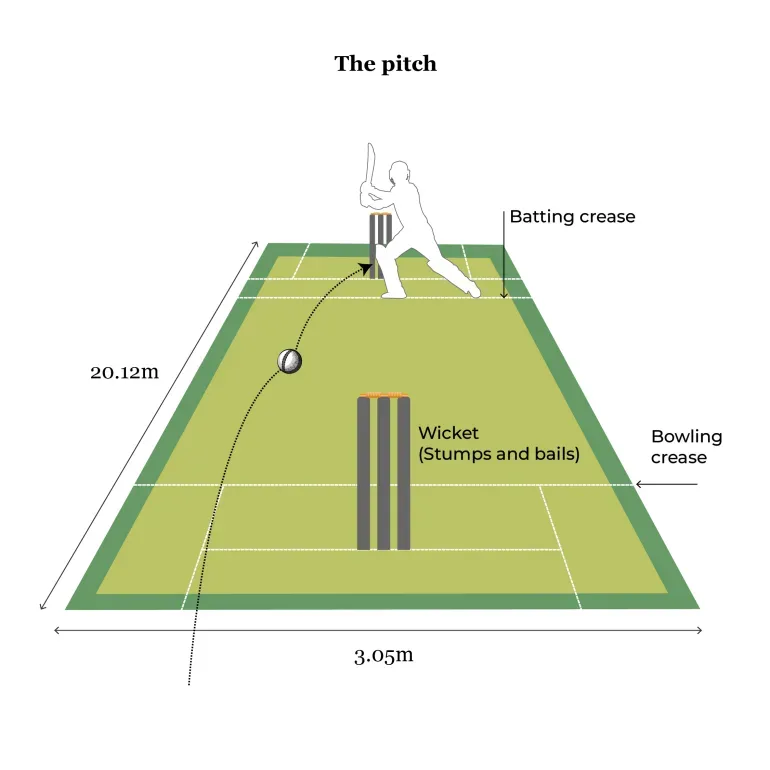
The cricket field is usually oval-shaped with a rectangular pitch in the center. The pitch is 22 yards long and has wickets at both ends. Each wicket consists of three stumps and two bails.
The batsman stands at one end, while the bowler runs in from the opposite end to deliver the ball. Fielders spread across the field to stop runs and take catches.
The boundaries mark the edge of the field, and hitting the ball beyond the boundary earns extra runs.
How Scoring Works in Cricket
Scoring is one of the most exciting parts of cricket. Runs can be scored in several ways.
When a batsman hits the ball and runs to the opposite end, one run is added. If both batsmen run back, another run is added. This can continue as long as they safely cross before the ball reaches the wicket.
If the ball reaches the boundary after touching the ground, it counts as four runs. If it crosses the boundary without touching the ground, it counts as six runs.
There are also extra runs called “extras” or “wides,” “no-balls,” “byes,” and “leg byes,” which are added to the team’s total even if the batsman does not hit the ball.
Wickets and How a Batsman Gets Out
Understanding how a batsman gets out is a key part of cricket rules explained. There are several ways a batsman can be dismissed.
A batsman is out if the bowler hits the wicket and dislodges the bails. This is called being bowled. A batsman is also out if a fielder catches the ball before it touches the ground.
Run-outs occur when fielders break the wicket while the batsman is running and has not reached the crease. Stumping happens when the wicketkeeper removes the bails while the batsman is outside the crease and not attempting a run.
Other methods include leg before wicket (LBW), where the ball hits the batsman’s leg in front of the wicket, and hit wicket, where the batsman accidentally knocks over their own wicket.
Overs, Deliveries, and Innings
An over consists of six legal deliveries bowled by a bowler. After six balls, another bowler takes over from the opposite end.
An innings is the period during which one team bats. In limited-overs cricket, each team has a fixed number of overs, such as 20 overs in T20 or 50 overs in ODIs. In Test cricket, there is no over limit, and teams bat until all players are out or they declare their innings closed.
The flow of overs and innings is what makes cricket strategic and exciting, as teams must balance scoring quickly with preserving wickets.
Powerplays and Fielding Restrictions
In limited-overs cricket, there are powerplay periods with fielding restrictions. During powerplays, only a certain number of fielders are allowed outside the inner circle.
This rule encourages aggressive batting and higher scoring during the early stages of an innings. Powerplays add drama and tactical depth to the game, especially in modern formats like T20 cricket.
No-Balls, Wides, and Free Hits
No-balls and wides are illegal deliveries that give extra runs to the batting team.
A no-ball occurs when the bowler oversteps the crease, bowls a dangerous delivery, or violates certain rules. A wide is called when the ball is too far from the batsman to hit.
In limited-overs cricket, a no-ball often results in a free hit, where the batsman cannot be dismissed by most methods. This rule adds excitement and encourages bowlers to maintain discipline.
Decision Review System (DRS) and Umpires
Cricket matches are controlled by on-field umpires who enforce the laws of the game. Umpires make decisions on dismissals, no-balls, wides, and other aspects of play.
Modern cricket uses the Decision Review System (DRS), allowing teams to challenge umpire decisions. Technology such as ball-tracking and edge detection helps ensure fair and accurate outcomes.
This combination of human judgment and technology makes cricket both traditional and modern at the same time.
Formats of Cricket and Rule Variations
Cricket is played in multiple formats, each with slight variations in rules and strategy.
Test cricket is the longest format, played over five days with two innings per team. ODIs are limited to 50 overs per team, while T20 matches are limited to 20 overs per team.
While the core laws remain consistent, shorter formats introduce innovations such as super overs, strategic timeouts, and powerplay variations to keep the game fast-paced and entertaining.
Spirit of Cricket and Fair Play
Beyond technical laws, cricket is guided by the “Spirit of Cricket,” which emphasizes sportsmanship, respect, and fair play. Players are expected to respect opponents, umpires, and the game itself.
This tradition is deeply rooted in cricket’s history and is one of the reasons the sport is admired worldwide.
Cricket rules explained for Beginners Watching Their First Match
For someone watching cricket for the first time, the game can seem confusing with its terminology and scoring system. However, once you understand the basics of runs, wickets, overs, and innings, the match becomes thrilling and easy to follow.
Imagine watching a batsman hit a six in the final over to win the match. Knowing the rules makes that moment unforgettable and emotionally powerful.
Common Cricket Terminology You Should Know
Cricket has a unique vocabulary that adds to its charm. Terms like “duck,” “century,” “maiden over,” and “hat-trick” are commonly used by commentators and fans.
A century means a batsman scored 100 runs in an innings. A duck means the batsman got out without scoring. A maiden over is an over with no runs scored. A hat-trick occurs when a bowler takes three wickets in three consecutive deliveries.
Learning these terms helps you understand commentary and enjoy the game like a seasoned fan.
Cricket rules explained for Scoring Records and Statistics
Cricket is famous for its detailed statistics and records. Players are judged by batting averages, bowling averages, strike rates, and economy rates.
These metrics help fans and analysts evaluate performance and compare players across eras. Understanding how runs and wickets are recorded makes cricket statistics meaningful and fascinating.
Safety Rules and Equipment in Cricket
Cricket players use protective equipment such as helmets, pads, gloves, and guards to prevent injuries. Bowlers can deliver the ball at high speeds, so safety is a priority.
Modern cricket also has strict concussion protocols and injury management systems to protect players’ health.
The Role of Captains and Team Strategy
The captain plays a crucial role in cricket. Captains decide the batting order, field placements, bowling changes, and whether to review umpire decisions.
Strategic decisions by captains often determine the outcome of matches. For example, choosing the right bowler in the final over can win or lose a game.
Cricket rules explained Through Real-Life Match Examples
Imagine a T20 match where the batting team needs 12 runs in the last over. The bowler delivers six balls, and the batsman hits two fours and a six while running a single. Understanding how each ball contributes to the total score helps you follow the tension and excitement of the game.
In Test cricket, a team may bat for hours to build a big score, then use bowlers strategically to dismiss the opposition. The rules create a balance between patience, skill, and strategy.
Umpire Signals and What They Mean
Umpires use hand signals to communicate decisions. Raising both arms means a six. Extending one arm horizontally means a wide. Touching the shoulder means a no-ball. Raising one finger means a batsman is out.
These signals are universal and allow players and spectators to understand decisions instantly, even without commentary.
How Weather and Pitch Conditions Affect Cricket
Pitch conditions and weather play a huge role in cricket. A dry pitch may favor spin bowlers, while a green pitch may help fast bowlers. Overcast conditions can assist swing bowling.
Understanding how conditions influence play is an advanced aspect of cricket knowledge, but it adds depth and appreciation for the sport.
Technology and Modern Cricket Rules
Cricket has evolved with technology. Hawk-Eye, UltraEdge, and other tools assist umpires in making accurate decisions. LED stumps, smart balls, and performance analytics are transforming how cricket is played and watched.
These innovations ensure fairness and enhance the viewing experience for fans around the world.
Why Understanding Cricket Rules Makes the Game More Fun
Knowing the rules transforms cricket from a confusing sport into an exciting story unfolding ball by ball. Every run, wicket, and over becomes meaningful when you understand the structure of the game.
Fans who understand the rules can predict strategies, debate decisions, and enjoy the tactical battles between batsmen and bowlers.
The Global Popularity of Cricket and Its Laws
Cricket is played in over 100 countries and has billions of fans worldwide. The International Cricket Council (ICC) governs the rules and ensures consistency across international matches.
Despite regional variations and local leagues, the fundamental laws of cricket remain the same, making it a truly global sport with a unified rulebook.
Advanced Rules: Follow-On, Declarations, and Super Overs
In Test cricket, the follow-on rule allows a team with a big lead to force the opposing team to bat again. Captains can also declare an innings closed to set a target for the opposition.
In limited-overs cricket, tied matches are decided by a super over, where each team plays one over to determine the winner. These advanced rules add drama and strategic depth to cricket.
Cricket Rules for Kids and Beginners
Cricket is often taught to kids with simplified rules, such as shorter pitches, fewer overs, and softer balls. These beginner-friendly formats help young players learn the basics and develop skills safely.
As players grow, they transition to full-length matches and official laws of cricket.
How Cricket Rules Have Evolved Over Time
Cricket rules have evolved significantly since the sport’s origins in England. Early cricket had fewer regulations, and many modern rules were introduced to improve safety, fairness, and entertainment.
For example, helmets were not mandatory in the past, and powerplays did not exist. The evolution of rules reflects cricket’s adaptation to modern audiences and professional standards.
The Importance of Knowing the Laws of Cricket
Understanding the laws of cricket is important not only for players but also for fans, coaches, and analysts. It helps avoid confusion and misinformation, especially when controversial decisions occur in matches.
Fans who know the rules can engage in meaningful discussions and appreciate the nuances of the sport.
Final Perspective on Learning Cricket Rules
Learning cricket rules is like unlocking a new language. Once you understand the basics, you can follow any match, from local games to international tournaments, with confidence and excitement.
Whether you are watching a thrilling T20 final or a classic Test match, knowing the rules will deepen your connection to the sport and enhance every moment of the game.
Read also:-
england cricket team vs west indies cricket team match scorecard
mumbai indians vs delhi capitals match scorecard
zimbabwe national cricket team vs new zealand national cricket team timeline
england cricket team vs new zealand national cricket team match scorecard
bangladesh national cricket team vs afghanistan national cricket team standings